Bambu Lab’s P1 line is designed to bring high-speed CoreXY performance to makers at different levels. The P1P offers a stripped-down, budget-focused entry into the platform, while P1S steps up with a more fully featured, enclosed chassis and added usability. If you want a 3D printer that keeps delivering without forcing compromises, P1S is the smarter middle path.
Let’s make long story short: Bambu Lab P1P sacrifices features to hit a lower price barebones but fast. P1S adds enclosure, smarter controls, and better all-round usability. P1S wins for most users who want high performance and fewer limitations or trade-offs.
Why Do I Recommend P1S?
- Enclosed, safer, more stable prints — P1S comes ready with full enclosure and filtered airflow, protecting your prints from drafts, temperature swings, and dust. P1P, while capable, is open by design. That makes P1S far more reliable for sensitive materials (ABS, PC, etc.).
- Better feature set out of the box — With P1S, you don’t have to add or upgrade to get advanced functionality. Auto bed leveling, power‑loss recovery, higher thermal stability — these are built into the S (sealed) model. P1P gives you the core speed, but you’ll find more missing elements you want to add later.
- Stronger print environment control — The enclosure and filtration of P1S help with temperature retention and odor control. If you ever print in a home or studio space, that sealed environment difference matters for quality and comfort.
- Same core motion power — but with fewer compromises — P1P and P1S both draw from Bambu’s speed architecture: 500 mm/s top speed, CoreXY motion, all‑metal hotend up to 300 °C. But P1S lets you use those capabilities in a controlled chassis, which means you’re less likely to suffer from print defects caused by external factors.
- Longer “safe lifespan” for your investment — Because P1S is more fully featured, you’re less likely to hit limitations you regret later. It gives you headroom: more material types, more consistent output, and less risk of outgrowing your machine too quickly.
- Perceived value & peace of mind — When someone sees you with P1S, it reads as “this is a serious rig.” That matters when showing off your prints or setting expectations. P1S gives confidence to you and to observers — that you’re not cutting corners.
In short: P1S doesn’t just match P1P’s core strengths — it completes them, with smarter enclosure, more consistency, and fewer trade-offs. If I were guiding someone buying now, I’d steer them to P1S every time.
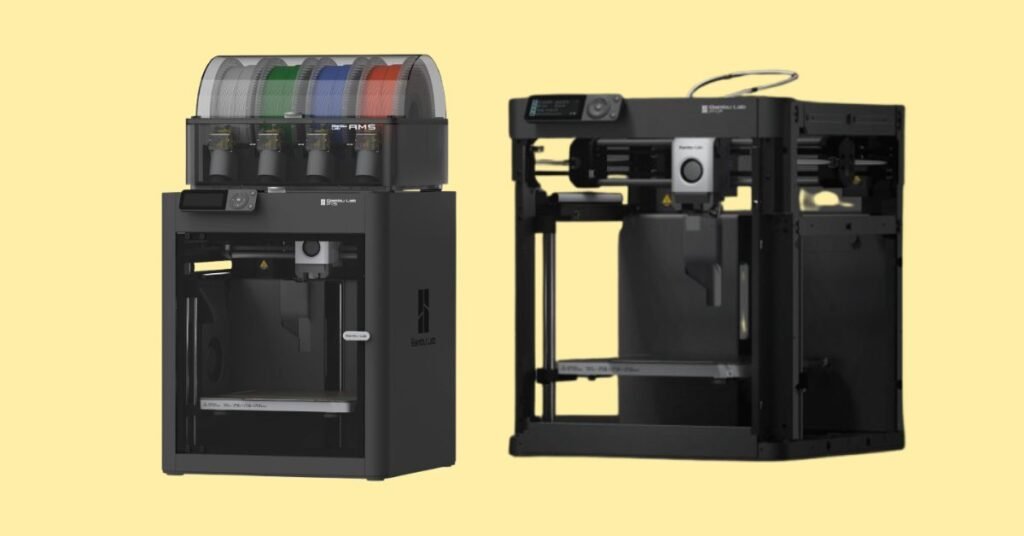
Detailed Comparison & Recommendation
| Feature / Spec | P1P | P1S | Which Is Best & Why? |
|---|---|---|---|
| Enclosure / chamber | Open frame / minimal housing | Full enclosure / shell to manage environment | P1S handles drafts, temperature better |
| Auto-leveling & convenience features | Basic auto leveling, but fewer extras | Auto bed leveling + more full functionality | P1S gives you fewer manual headaches |
| Speed & motion architecture | Up to 500 mm/s, core platform speed preserved | Up to 500 mm/s; same core motion architecture | Tie — both share the same high-speed skeleton |
| Material handling & output consistency | Prone to more environmental effects (warping, draft) | Better for ABS, PC, and harsher filaments thanks to enclosure | P1S is safer for a broader material range |
| Check Best Seller | Check Bambu Lab P1P Lowest Price | Check Bambu Lab P1S Lowest Price | P1P wins on low entry; P1S wins on lower regret |
What Is the Major Difference Between P1P vs P1S
- Environment control — P1S’s enclosure gives you better performance with temperature-sensitive materials.
- Usability & completeness — P1S ships with more features active, reducing the need for upgrades or workarounds.
- Longer-term flexibility — With P1S, you’re less likely to hit a limit and need to upgrade.
Check Bambu Lab P1S Limited Time Deal Here
What Users Are Saying About Bambu Lab P1P vs P1S
- Tom’s Hardware on P1P: > “The P1P is capable of hitting 500 mm/s … a no‑frills, skeletal version of X1 Carbon with many premium features removed.”
- Tom’s Hardware on P1S: > “The P1S hits a sweet spot … affordable Core XY speed for a wide range of materials and access to Bambu Lab’s popular AMS system.”
- All3DP: P1P retains the 500 mm/s capability while trimming down features to hit a more aggressive price point.
- Forum feedback: > “Currently the P1S is only $100 more than the P1P. You can’t upgrade a P1P for that price … You will regret it otherwise.”
Fair Advice to Consider
- Choose P1P if you: Trust yourself to live with missing premiums and want lower upfront cost. Mostly print PLA / PETG in well-controlled environments. Plan to put funds into upgrades yourself
- Choose P1S if you: Want a more polished, “just works” experience. Print ABS, PC, or materials sensitive to enclosure / temperature. Prefer to minimize regrets and future upgrade pressure
Quick Comparison – Spec Highlights
| Feature | P1P | P1S |
|---|---|---|
| High-speed CoreXY base | ✅ | ✅ |
| Enclosure / environmental control | ❌ | ✅ |
| Convenience features included | ⚠ minimal | ✅ |
| Better for demanding materials | ❌ | ✅ |
| Recommended Best Seller | Check Bambu Lab P1P Lowest Price | Check Bambu Lab P1S Lowest Price |
Quick Summary
If you’re chasing the absolute lowest cost while still getting CoreXY speed, P1P offers impressive performance but you’ll give up in environmental control and built-in features. P1S gives you that same speed, plus an enclosure, more features, and fewer compromises. For most users who don’t want to tinker endlessly, P1S is the better balance of power, usability, and value.
FAQs
Can you add the missing features from P1P to match P1S later?
To some extent, but key differences like the enclosure or integrated features may not retrofit cleanly.
Does P1P have auto bed leveling?
Yes — it retains auto-bed leveling and some core automation, but not all of the extras.
Will P1P perform well for ABS / PC?
In well-controlled ambient environments, yes — but P1S’s enclosure gives more confidence in tougher materials.
Which one has better resale or longer life?
P1S probably retains more value, as fewer buyers will want to buy into a stripped-down platform.
Which is better for beginners?
P1S, because the extra features reduce the chances of confusion or failed prints during learning.
Jump To